
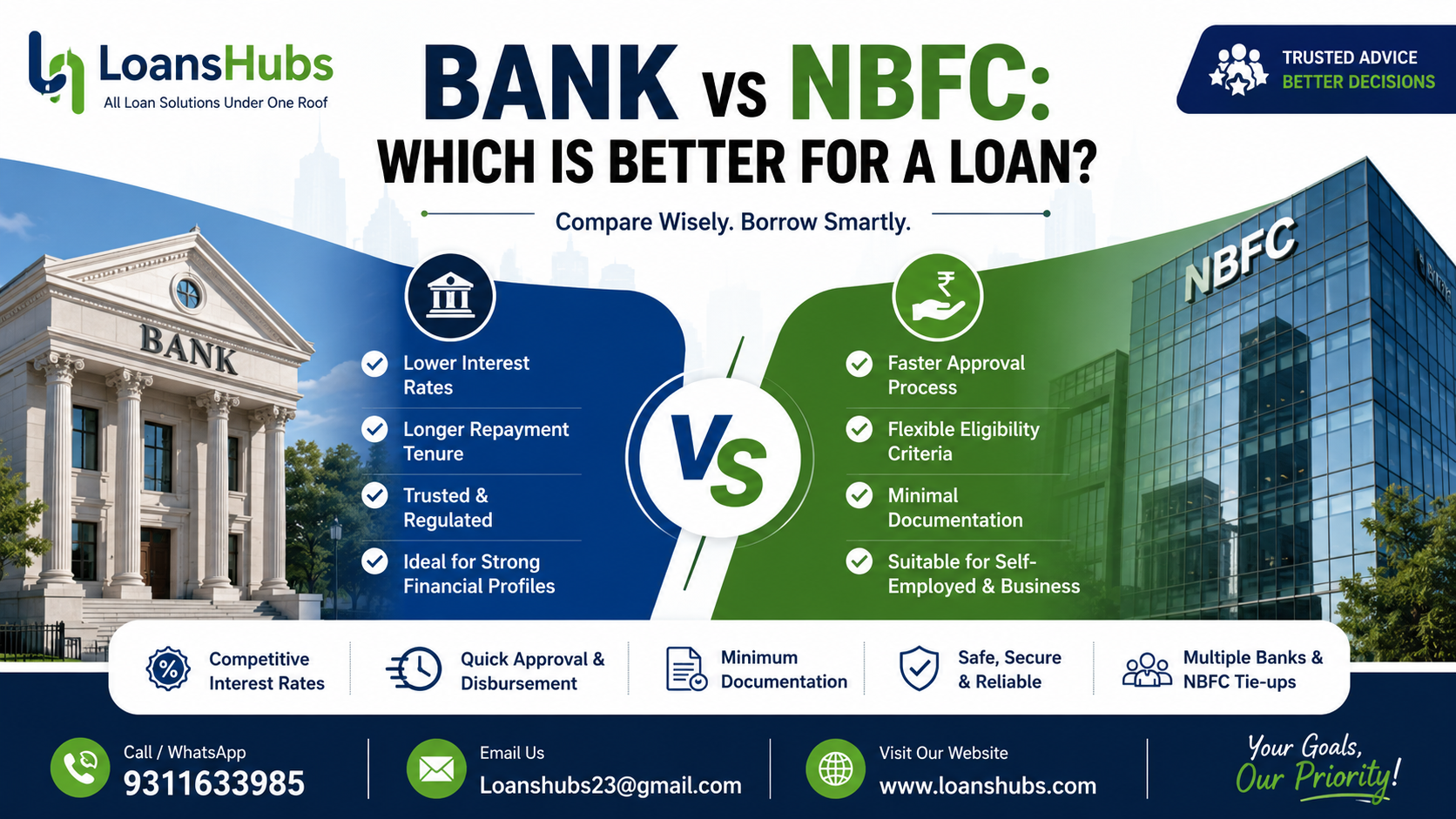
Bank vs NBFC: Which Is Better for a Loan?
When you need financial support, choosing the right lender can be just as important as choosing the right loan. In India, borrowers usually have two major options: Banks and Non-Banking Financial Companies (NBFCs).
Both offer different types of loans, including home loans, business loans, personal loans, vehicle loans, and loans against property. However, their eligibility criteria, interest rates, approval processes, and documentation requirements can be different.
So, which option is better for you—a bank or an NBFC? The answer depends on your financial profile and borrowing needs.
What Is a Bank?
A bank is a financial institution that accepts deposits and provides financial services such as loans, savings accounts, fixed deposits, and credit facilities. Banks generally have structured lending policies and may offer competitive interest rates to eligible borrowers.
Most borrowers prefer banks because they are well-established and often provide lower interest rates, especially to applicants with a strong income profile and good credit history.
Advantages of Taking a Loan from a Bank
Lower Interest Rates
Banks may offer attractive interest rates, particularly to borrowers with a good CIBIL score and stable income.
Longer Repayment Tenure
For loans such as home loans and loans against property, banks may provide longer repayment periods, helping borrowers manage their monthly EMIs.
Wide Range of Financial Products
Banks offer various products under one roof, including savings accounts, loans, credit cards, insurance, and investment services.
Good for Strong Financial Profiles
If you have stable employment, regular income, proper documentation, and a good credit score, a bank can be a suitable option.
Limitations of Banks
The loan approval process can sometimes take longer. Banks may also have stricter eligibility requirements and detailed documentation processes. Applicants with a low CIBIL score or irregular income may find it more difficult to get approval.
What Is an NBFC?
NBFC stands for Non-Banking Financial Company. NBFCs provide financial services and offer different types of loans, although they operate differently from traditional banks.
NBFCs are often known for flexible lending solutions and faster processing. They may consider borrowers who do not meet all the traditional eligibility requirements of banks.
Advantages of Taking a Loan from an NBFC
Flexible Eligibility Criteria
NBFCs may offer more flexibility when evaluating loan applications. This can be helpful for self-employed individuals, business owners, and people with non-traditional income sources.
Faster Loan Processing
Many NBFCs focus on quicker processing and simplified procedures, which can be useful when funds are required urgently.
Suitable for Different Borrower Profiles
Borrowers with limited credit history, irregular income, or unique financial situations may find more suitable options with certain NBFCs.
Less Complicated Documentation in Some Cases
Depending on the lender and loan type, the documentation process may be simpler than that of a traditional bank.
Limitations of NBFCs
The interest rate offered by an NBFC may sometimes be higher than that offered by a bank. Borrowers should also carefully review processing fees, foreclosure charges, and other applicable costs before accepting an offer.
Bank vs NBFC: A Quick Comparison
| Factor | Bank | NBFC |
|---|---|---|
| Interest Rates | Often competitive for eligible borrowers | May vary and can sometimes be higher |
| Approval Process | May be more detailed | Often faster and more flexible |
| Documentation | Usually more structured | May be comparatively simpler |
| Eligibility | Can be stricter | Often more flexible |
| CIBIL Requirements | Generally important | May consider wider borrower profiles |
| Best For | Salaried and financially strong applicants | Self-employed and flexible borrowing needs |
Which Is Better for a Home Loan?
If you have a stable income, strong credit score, and complete financial documents, a bank may offer a competitive home loan option.
However, if your income structure is different, you are self-employed, or you need a more flexible approach, an NBFC may provide suitable options.
The best choice is not always the lender with the lowest advertised interest rate. You should compare the complete loan offer, including:
- Interest rate
- Processing fee
- Loan amount
- Repayment tenure
- EMI amount
- Prepayment charges
- Foreclosure conditions
- Other applicable fees
Which Is Better for a Business Loan?
For established businesses with strong financial records, banks can be a good choice. However, many small businesses and self-employed professionals may prefer NBFCs because of their flexible approach.
Business owners should compare multiple offers before making a decision. A slightly faster approval may be useful, but the overall cost of the loan should also be considered.
Things to Check Before Choosing Any Lender
Before applying for a loan from either a bank or an NBFC, keep these points in mind:
1. Check Your CIBIL Score
A good credit score can improve your chances of getting better loan terms. Check your credit report and correct any errors before applying.
2. Compare Interest Rates
Do not choose a lender based only on advertisements. Compare the actual interest rate offered to you.
3. Calculate Your EMI
Make sure the monthly EMI comfortably fits your budget. Borrowing more than you can repay can create financial stress.
4. Understand All Charges
Ask about processing fees, legal charges, valuation charges, insurance requirements, and prepayment penalties.
5. Read the Loan Terms Carefully
Always understand the repayment schedule and loan conditions before signing the agreement.
Final Thoughts
There is no single answer to whether a bank or NBFC is better for a loan. Banks can be a great choice for borrowers with strong financial profiles who are looking for competitive terms. NBFCs can be useful for borrowers who need flexibility, faster processing, or solutions based on different income profiles.
The right decision depends on your income, credit score, loan requirement, repayment capacity, and the terms offered by the lender.
At LoansHubs, you can explore suitable loan options based on your individual financial requirements. Comparing different lenders and understanding the complete loan terms can help you make a more informed borrowing decision.
Before taking any loan, always borrow responsibly and choose an EMI that fits your financial situation.






Leave a Reply