

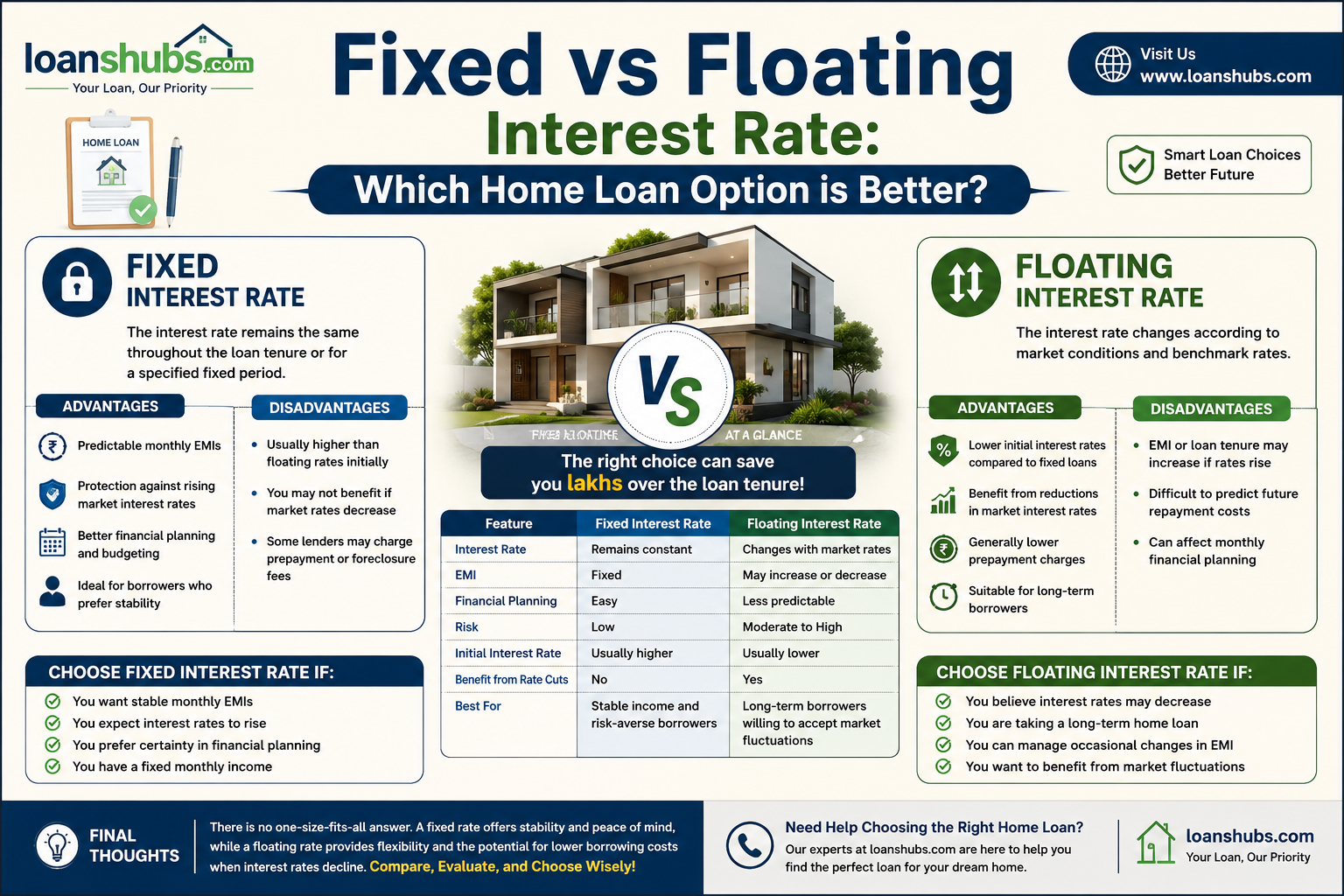
Fixed vs Floating Interest Rate: Which Home Loan Option is Better?
When applying for a home loan, one of the most important decisions you’ll make is choosing between a fixed interest rate and a floating interest rate. The interest rate you select directly impacts your monthly EMI, the total interest you pay, and your overall financial planning. Understanding the differences between these two options can help you choose the home loan that best suits your financial goals.
What is a Fixed Interest Rate?
A fixed interest rate remains unchanged throughout the loan tenure or for a specified period, regardless of changes in market interest rates. This means your monthly EMI stays the same, making it easier to plan your finances.
Benefits of a Fixed Interest Rate
- Stable EMIs: Your monthly installment remains constant, helping you manage your budget effectively.
- Protection from Market Fluctuations: If interest rates increase in the future, your loan cost remains unaffected.
- Easy Financial Planning: Since your EMI doesn’t change, you can plan your monthly expenses with confidence.
- Peace of Mind: Fixed-rate loans provide certainty, especially during periods of economic uncertainty.
Drawbacks of a Fixed Interest Rate
- Fixed rates are generally higher than floating rates at the beginning.
- You won’t benefit if market interest rates decline.
- Some lenders may charge higher prepayment or foreclosure fees.
What is a Floating Interest Rate?
A floating interest rate changes according to market conditions and benchmark lending rates set by the bank or financial institution. As interest rates rise or fall, your EMI or loan tenure may also change.
Benefits of a Floating Interest Rate
- Lower Initial Interest Rates: Floating rates often start lower than fixed rates.
- Benefit from Rate Cuts: If market interest rates decrease, your loan becomes cheaper.
- Lower Prepayment Charges: Many lenders offer flexible prepayment options for floating-rate loans.
- Ideal for Long-Term Loans: Over an extended period, borrowers may benefit from falling interest rates.
Drawbacks of a Floating Interest Rate
- Your EMI or loan tenure may increase if interest rates rise.
- Monthly budgeting becomes less predictable.
- Long-term loan costs may increase during periods of rising interest rates.
Fixed vs Floating Interest Rate: Quick Comparison
| Feature | Fixed Interest Rate | Floating Interest Rate |
|---|---|---|
| Interest Rate | Remains constant | Changes with market conditions |
| EMI | Fixed | Can increase or decrease |
| Financial Planning | Easy | Less predictable |
| Risk Level | Low | Moderate |
| Initial Rate | Usually higher | Usually lower |
| Benefit from Rate Cuts | No | Yes |
| Best For | Stable income earners | Long-term borrowers |
Which Home Loan Option Should You Choose?
The right choice depends on your financial situation, income stability, and risk tolerance.
Choose a Fixed Interest Rate If:
- You prefer stable monthly EMIs.
- You have a fixed monthly income.
- You expect interest rates to increase in the future.
- You value certainty in financial planning.
Choose a Floating Interest Rate If:
- You are comfortable with market fluctuations.
- You expect interest rates to decline.
- You are taking a home loan for a long tenure.
- You want to reduce your overall interest cost over time.
Factors to Consider Before Choosing
Before deciding between fixed and floating interest rates, consider these important factors:
- Your monthly income and financial commitments.
- Current and expected market interest rate trends.
- Loan tenure and repayment capacity.
- Prepayment and foreclosure policies of the lender.
- Your comfort level with changing EMIs.
Comparing loan offers from different banks and housing finance companies can also help you find the most suitable option.
Conclusion
Both fixed and floating interest rates have their own advantages and limitations. A fixed interest rate offers stability, predictable EMIs, and better financial planning, making it ideal for borrowers who prefer certainty. On the other hand, a floating interest rate provides flexibility and the opportunity to save on interest when market rates decline, making it a suitable choice for long-term borrowers who can manage occasional EMI fluctuations.
Before finalizing your home loan, carefully evaluate your financial goals, compare interest rates from multiple lenders, and understand all associated charges. Choosing the right interest rate can significantly reduce the overall cost of your home loan and help you achieve your dream of homeownership with greater financial confidence.
SEO Keywords: Fixed Interest Rate, Floating Interest Rate, Home Loan Interest Rate, Home Loan EMI, Housing Loan, Mortgage Loan, Fixed vs Floating Interest Rate, Home Loan Tips, Best Home Loan, LoansHubs.




Leave a Reply