
Important Property Documents You Should Know Before Buying a Property
Buying a property is one of the biggest financial decisions you may make. Whether you are purchasing a home, commercial property, or investing in real estate, checking the property’s legal and ownership documents is extremely important.
Proper documentation helps you verify ownership, identify possible legal issues, and make the property transaction safer. These documents can also play an important role when applying for a Home Loan or Loan Against Property (LAP).
In this guide, we explain some of the most important property documents you should know before buying a property in India.
1. Sale Deed
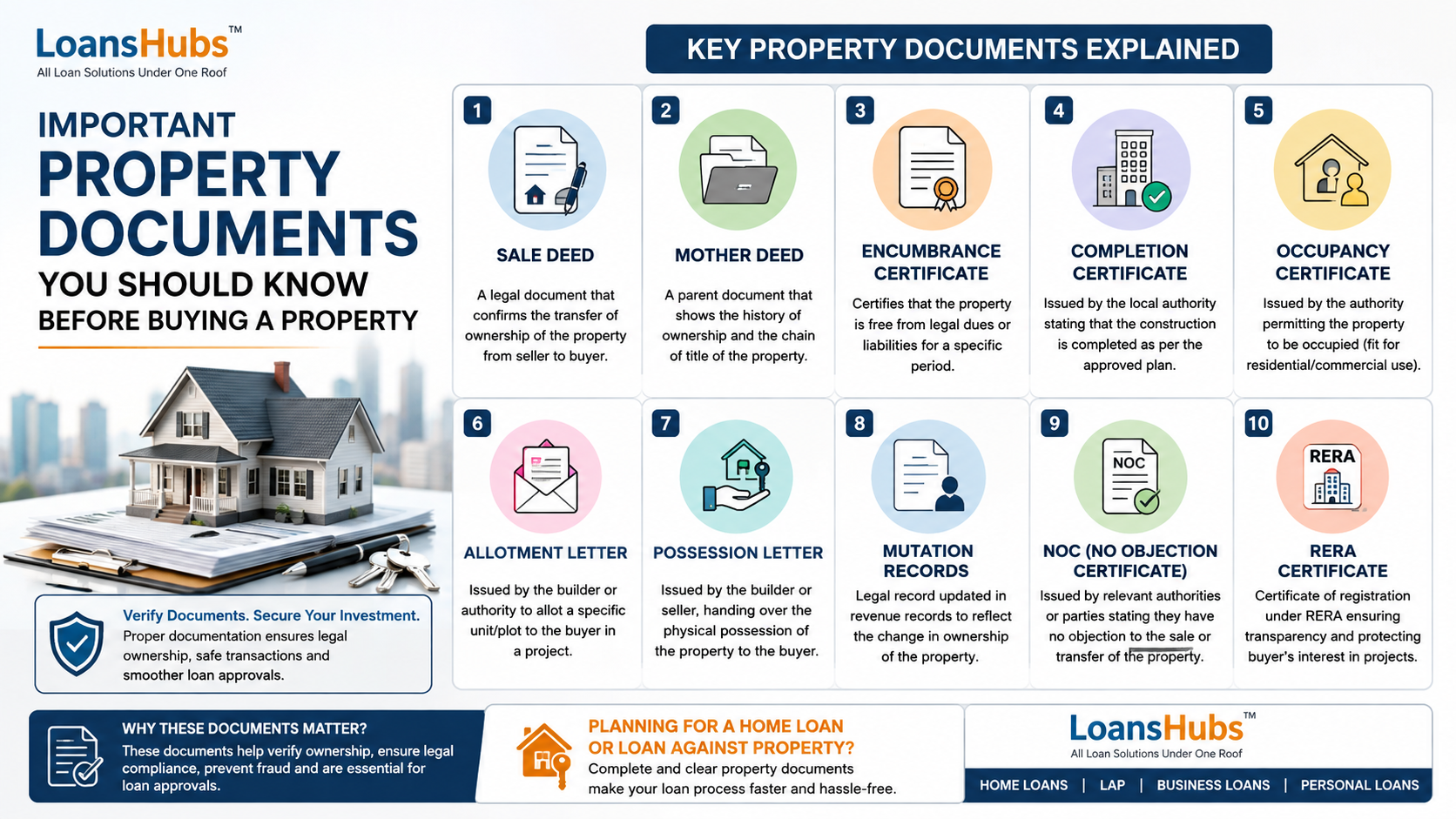
A Sale Deed is one of the most important documents in a property transaction. It records the transfer of ownership of a property from the seller to the buyer.
The sale deed generally contains details such as:
- Name and details of the buyer and seller
- Property description
- Sale consideration
- Property boundaries
- Payment details
- Terms and conditions of the transaction
A properly executed and registered sale deed provides important evidence of the transfer of ownership.
Why Is a Sale Deed Important?
Before purchasing a property, buyers should verify the sale deed and ensure that the seller has the legal right to sell the property.
It is also an important document during the legal verification process for property-related loans.
2. Mother Deed
A Mother Deed, also called a parent document in some contexts, is a document that traces the historical ownership of a property.
It helps establish how the property has been transferred from one owner to another over time.
A mother deed may contain a chain of previous transactions, such as:
Previous Owner → Subsequent Owner → Current Owner
Why Is Mother Deed Important?
The mother deed helps in checking the property’s ownership history and identifying whether there are gaps or inconsistencies in the title chain.
For buyers, verifying the property’s title history is an important part of due diligence.
3. Encumbrance Certificate (EC)
An Encumbrance Certificate, commonly known as an EC, provides information about registered transactions and certain registered encumbrances relating to a property for a specified period.
It can help buyers check whether the property has recorded transactions such as registered sales, mortgages, or other relevant entries during the period covered by the certificate.
Why Is an Encumbrance Certificate Important?
An EC can help in identifying registered claims or transactions associated with the property.
It is particularly useful when purchasing a property or applying for property financing.
However, an EC should not be treated as the only document required to establish that a property has a clear title.
4. Completion Certificate (CC)
A Completion Certificate is issued by the relevant local authority after a building or development has been completed according to the approved plans and applicable requirements, subject to the authority’s rules.
It generally confirms that the construction has been completed as per the sanctioned plan and applicable building regulations.
Why Is a Completion Certificate Important?
Before purchasing a completed property, buyers should check whether the required completion-related approvals have been obtained.
This document can also be relevant during property verification for financing.
5. Occupancy Certificate (OC)
An Occupancy Certificate is generally issued by the competent authority after verifying that a building is suitable for occupation according to applicable requirements.
It indicates that the completed building has met the relevant conditions for occupancy, subject to local regulations.
Difference Between CC and OC
Although both documents are related to completed construction, they are not the same.
Completion Certificate: Generally relates to completion of construction according to approved plans and requirements.
Occupancy Certificate: Generally relates to permission/confirmation that the completed building can be occupied, subject to applicable rules.
The exact terminology and requirements can vary by local authority.
6. Allotment Letter
An Allotment Letter is commonly issued by a developer or housing authority to a buyer when a property or unit is allotted to them.
It may contain details such as:
- Allottee’s name
- Property or unit number
- Project details
- Sale price
- Payment schedule
- Terms and conditions
Why Is an Allotment Letter Important?
It provides evidence that a particular property or unit has been allotted to the buyer.
In some property transactions, it can also form part of the documentation required by lenders or authorities.
7. Possession Letter
A Possession Letter is generally issued by the developer or seller when possession of the property is handed over to the buyer.
It may mention:
- Property/unit details
- Possession date
- Buyer’s details
- Handover information
- Relevant terms and conditions
Why Is Possession Letter Important?
It provides a record of the handover of the property to the buyer.
For a homebuyer, it is important to keep this document safely with other property records.
8. Mutation Certificate
Mutation refers to updating the property records maintained by the relevant local authority or revenue department to reflect a change in ownership or other relevant property details.
The document or record issued as evidence of mutation may vary depending on the state and local authority.
Why Is Mutation Important?
Mutation helps update government or local records after a property transaction.
However, mutation by itself generally does not replace the registered title document or conclusively establish ownership.
9. NOC – No Objection Certificate
A No Objection Certificate (NOC) is a document issued by a relevant authority, organization, society, developer, or other concerned party stating that it has no objection to a specified transaction, activity, or change, depending on the circumstances.
Different types of NOCs may be required for different property transactions.
For example:
- Society NOC
- Builder NOC
- Bank NOC
- Authority NOC
- NOC related to specific permissions
Why Is NOC Important?
A required NOC can help confirm that the concerned authority or party does not object to the proposed transaction or activity.
The exact NOC required depends on the property and transaction.
10. RERA Certificate and RERA Registration
The Real Estate (Regulation and Development) Act, 2016 (RERA) was introduced to improve transparency and accountability in the real estate sector.
Under RERA, eligible real estate projects generally need to be registered with the relevant state or Union Territory RERA authority before being advertised or sold, subject to applicable exemptions.
A buyer should check the project’s RERA registration details on the relevant state/UT RERA portal.
Why Is RERA Registration Important?
RERA registration can provide buyers with access to important project information, which may include:
- Promoter details
- Project details
- Approved plans
- Project completion information
- Litigation-related disclosures, where applicable
- Registration details
- Other disclosures required under RERA
Before investing in an under-construction project, checking its RERA registration is an important step.
Why Are Property Documents Important for Home Loans?
When you apply for a Home Loan, the lender generally performs legal and technical verification of the property.
Depending on the property and transaction, the lender may ask for documents such as:
- Sale Deed
- Previous title documents/Mother Deed
- Encumbrance Certificate
- Approved building plan
- Completion Certificate
- Occupancy Certificate
- Allotment Letter
- Possession Letter
- Mutation records
- NOCs
- RERA-related documents
The exact documents required vary depending on the lender, property type, location, project, and transaction.
Property Documents for Loan Against Property
If you are planning to take a Loan Against Property (LAP), the lender may also require property ownership and legal documents to verify the property offered as security.
The lender may assess:
Property Title + Legal Documents + Property Value + Applicant’s Income + Credit Profile
A clear and verifiable property title can make the legal verification process smoother.
Property Document Checklist
Before buying a property, consider checking the following:
| Document | Main Purpose |
|---|---|
| Sale Deed | Evidence of transfer of ownership |
| Mother Deed | Helps trace ownership history |
| Encumbrance Certificate | Shows registered transactions/encumbrances for the covered period |
| Completion Certificate | Relates to completion of construction |
| Occupancy Certificate | Relates to permission/confirmation for occupation |
| Allotment Letter | Records allotment of a property/unit |
| Possession Letter | Records handover of possession |
| Mutation Record/Certificate | Updates relevant government/local records |
| NOC | Confirms no objection from the relevant authority/party |
| RERA Registration | Provides project information and regulatory registration details |
Final Checklist Before Buying a Property
Before making a major payment or signing a property agreement, consider:
✅ Verify the seller’s identity and ownership documents.
✅ Check the property’s title history.
✅ Review the sale deed and previous title documents.
✅ Obtain/check the relevant Encumbrance Certificate.
✅ Verify applicable approvals and building documents.
✅ Check Completion and Occupancy Certificates where applicable.
✅ Verify the allotment and possession documents for developer properties.
✅ Check mutation records where applicable.
✅ Obtain relevant NOCs where required.
✅ Check RERA registration for applicable projects.
✅ If taking a Home Loan or LAP, confirm the lender’s document requirements in advance.
Conclusion
Property documents are an important part of buying, selling, and financing real estate. Documents such as the Sale Deed, Mother Deed, Encumbrance Certificate, Completion Certificate, Occupancy Certificate, Allotment Letter, Possession Letter, Mutation Records, NOC, and RERA registration details help establish and verify different aspects of a property transaction.
However, no single document should be considered sufficient on its own. Buyers should review the complete document chain and, where appropriate, take advice from a qualified property lawyer before completing a major transaction.
If you are planning to buy a property or need financing against your property, LoansHubs can help you explore suitable loan solutions including Home Loan and Loan Against Property.
LoansHubs – All Loan Solutions Under One Roof
Fast Process. | Best Advice. | 100% Support.





Leave a Reply